|
Future Trends in Human Resources
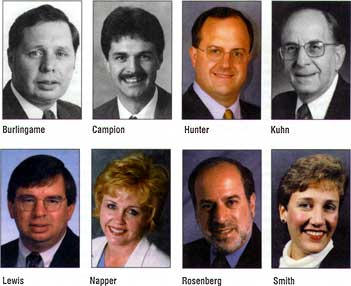
What are the most important trends and developments likely to affect businesses and their employees in the next ten years? As the pace of change accelerates through the next century, this question is looming larger in the minds of corporate and human resources leaders. How will the workplace change? What will be the new role of training and human resources? Will technology play a bigger role in the development of people? And how will all these issues affect individual careers? These were among the issues addressed in a recent panel discussion conducted by Talent Alliance, a non-profit, virtual network (www.talentalliance.org) dedicated to helping people build the skills they'll need in their careers. According to John McMorrow, president and CEO of Talent Alliance, employees need support through a whole range of career events. Some are traditional milestones, like starting a new job, being promoted, or preparing for retirement. Others are new workplace events stemming from mergers, acquisitions and downsizing. "When we think of careers, we must think more broadly", said McMorrow. "While we should always be attentive to traditional career milestones, we also must focus on the realities of how people work now." To understand the changing nature of careers and how human resources will evolve over the next few years, Talent Alliance assembled a blue-ribbon panel of human resources executives, leading academics, and representatives from strategic HR and training consulting firms. During the panel discussion, some key areas of consideration emerged, including global competition, outsourcing, training and education, the growth of technology and quality-of-life issues. Global Competition for Business and Jobs "Global competition will have a profound impact on businesses", said Michael Campion, professor of management at Purdue University. In a similar vein, Kerry Bunker, senior program associate at the Center for Creative Leadership, noted that the globalization of both the marketplace and the workforce presents great challenges and opportunities. "It is imperative", said Bunker, "that the U.S. treat its people as a national resource if we are to continue to strive and thrive in a world that is becoming smaller and more competitive at an exponential rate." Clearly, competition for jobs will also become global. With products produced around the world, and with the ability of technology to link managers together from dozens of countries, people in Indiana may be working with people in India, and employees in Dublin, Ireland, may be competing for jobs with employees in Dublin, Ohio. According to Joel Krauss, managing principal of Chicago-based OmniTech Consulting Group, Inc., "We're going to see an increase in people moving to another country as part of a career change." And they better be prepared. Independent marketing and change management consultant Brenda Smith noted that global business skills, a global mindset and second-language proficiency will be key ingredients for success in an increasingly global workplace. Panel experts agreed that pail of the solution to employee globalization is more emphasis on training and development, and on career planning that has an international focus. Career Change as a Way of Life The increasing incidence of career change is reinforcing the concept of job portability. Today, workers know that a career can be composed of more than one job or company. OmniTech's Krauss said that increasing numbers of people are making mid-life career changes and learning to adjust to workplaces with no lifetime employment guarantee. His perspective was echoed by Jeff Hunter, president of e-business solutions provider DataMain [now Euphorion], who pointed to the erosion of the implied goodfaith contract between employer and employee. Hunter called this "the most significant single issue in workforce management and development over the next ten years." Career change will become the rule rather than the exception, and as a result, career development will, out of necessity, become a continuous, lifelong process. The Rise of Outsourcing: Opportunities and Challenges The growing importance of career development also stems from other significant changes underway in many corporations. One is an increasing level of outsourcing, as more companies transfer internal operations to outside service providers who can do the job better and more efficiently. In response to this demand, outsourcing companies of all sizes have sprung up. At the same time, downsized or otherwise at-risk employees are increasingly finding employment with the outsourcing firms that replaced them, or are joining the growing contingent workforce selling its services back to larger businesses. Seth Grimes, principal at Internet consulting firm Alta Plana, sees the move toward a contractual and ad-hoc workforce, and away from traditional, long-term employer-employee relationships, as a positive development. "Employers will increasingly become customers for contractual employees", said Grimes. Will this trend increase in the future, or will the more traditional employment relationship return? Our panel suggested that both forms of work are here to stay, with the flexible, contingent workforce becoming increasingly important. "Perhaps one of the benefits of outsourcing is that it focuses the business on its true core competencies", noted Harold Burlingame, executive vice president of AT&T. He believes that it's critical for HR professionals to understand not only what they're good at, but also which functions they should retain close control of, and which can be outsourced. "We no longer can do everything", said Burlingame. "In determining what should be outsourced and what should be retained, our value is in helping the business make the right choices." Continuous Learning: The Key to Career Success As people change jobs more frequently, as they work across geographic and cultural boundaries, and as many become associated more with a single profession than a single company, continuous learning will take center stage. Talent Alliance member companies have increasingly pointed out the need to obtain employees with new skill sets. But in today's economy there simply are not enough educated new hires to go around. Some members of the panel said that the problem lies with the source of young, new workers - the schools. "Here's a growing gap between the skill needs of industry and what the public education system can provide", says Brian Lynch of Armstrong World Industries. If there simply isn't enough high-quality workers to meet the needs of global businesses, then more emphasis must be placed on continuous learning and retraining of existing workers. "The issue is not only how to hire people with fundamentally different skill sets", argued Gary Lewis, project manager at DuPont, "but how to retrain the existing workforce." Today, educational institutions - from community colleges to prestigious universities - are retooling to meet the needs of business. Education is also booming in the private sector, as organizations make alliances with commercial-education service providers. Moreover, providers of education are delivering more of their programs in corporate customers' classrooms, conference rooms and cafeterias - wherever there is need. Jim Smither, professor of management development at LaSalle University, said there is a shift away from traditional classroom-based education. He pointed to new hybrid universities, such as the University of Phoenix, which is a for-profit, non-campus institution, as harbingers of things to come. Smither likened the change in education to what has occurred in healthcare. "Just as managed care has transformed the way medical practice is delivered", said Smither, "so will for-profit, distance learning transform the way education is delivered." The panel saw several implications stemming from the changing nature of education. First, education will no longer be separated from daily life, and more and more people will try to fit it into their daily schedules, at work and at home. Education delivery will quickly become a 24-hour, seven-day-a-week service. But an important issue is whether employers will allow time for learning, either "on the clock" or through time away from work. Another concern is whether companies will continue to pay for education. The Talent panel suggested that companies will support education, knowing they will receive a return on their investment. Does this mean that traditional education will become a memory? "I don't think so", noted Allison Rossett, professor of educational technology at San Diego State University. The problem, she said, is that not all employees are suited for the independent learning delivered by innovative programs. She suggested that people become successful learners by developing skills related to "learning how to learn." Both independent learning and traditional classroom education will be important to employers and employees, and will complement each other. Whatever the form of education delivery, the Talent panel stressed that continuous learning is key to a successful career. As mergers and acquisitions, downsizing and other events radically change the corporate landscape over the next few years, employees will have to keep their skills and knowledge razor sharp to remain competitive in their careers. As corporations compete for high-quality people, education will emerge as both a necessity and an employee benefit. "New hires will begin seeking opportunities to advance their capabilities", noted Marc Rosenberg, senior consultant with OmniTech Consulting Group, Inc. Rosenberg believes that employees understand the value of knowledge. "They will expect their employers to help them stay on the cutting edge", he said. "Otherwise, they'll go someplace else." DataMain's [now Euphorion's] Jeff Hunter agreed, noting that in the future, the law of supply and demand for highly educated employees will dominate recruiting efforts. The Explosive Growth of Technology-Based Learning Because more demands are being put on employees, investment in education is increasing. Corporate spending on training is up 26% over the last five years, according to the latest survey done by Training Magazine (October 1998). And technology, along with non-traditional institutions, will radically change the way education is delivered. Programs like Duke University's executive MBA program and Penn State University's World Campus, conducted largely over the Internet, will become even more attractive. In the private sector, hundreds of companies are now selling online. From IT to sales training, the Internet - and intranet - is becoming a dominant force in corporate learning. Walter Tomow, senior fellow at the Center for Creative Leadership, believes that technology will continue to be used for both performance improvement and communications. Many on the Talent panel noted that the Internet is more than a learning or HR tool; it is the lifeblood of business and "the primary vehicle for commerce and data exchange." In addition, the Internet has dramatically changed the economic model of education delivery, since it makes education available to anyone with a computer, at any time and at any location. And the Internet is cost-effective since it uses a fraction of the business's infrastructure. For these reasons, the panel noted, the World Wide Web will not wither away like so many previous technological innovations. Are We Ready for "Instant Knowledge"? What happens when technology enables greater access to greater amounts of information, and when workers increasingly need that information, and need it quicker, to do their jobs? Will they be capable of handling the information glut? Do we fully understand the implications of a much faster, more informed work environment, and will businesses suffer when too much information becomes contradictory or clogs the system? David Jones, professor of management development at LaSalle University, thinks these issues could create huge problems in the future. "The ability to sort through large amounts of immediate information may become one of the new managerial skills", he said. HR professionals certainly will need this new skill. According to Stacy Napper, vice president of HR operations at GTE, "We will probably be most affected by the need for immediate, just-in-time information, data, trends and services." The panel saw great challenges ahead if the potential of technology is to be realized. "Simply managing these emerging and evolving technologies will be a big task", noted Manuel London, professor of management and director of the Center for Human Resource Management at the State University of New York at Stony Brook. "The changes in technology, combined with the rapidly changing economic scene, make continuous learning, employee involvement and commitment all the more challenging", he said. Several panel members also saw differences in employee demographics as a key challenge to using the new technology. "People need training on how to reach this medium", says Mark Mehler, co-author of CareerXRoads, the 1999 directory of the 500 best job, resume and career management sites on the Web. "Older employees must know how to use a computer; that training is critical", he noted. Don Kuhn, executive director of UNICON (The International University Consortium for Executive Education), pointed to "the division between those who are computer literate and those who are not" as a major problem area where more must be done. Organizations also fall into the two categories: technology-capable and the technology-weak. Creating opportunities that allow organizations to develop technological skills may become a public-policy issue in the future. Quinn Mills, professor of business administration at Harvard University, advocates business-government partnerships at the local and regional level to promote infrastructure. "If you don't have the infrastructure, everything else must wait until you do", pointed out Marc Rosenberg of OmniTech Consulting. The benefits that come from partnerships are not limited to technology. "In most of the companies I know, HR executives are looking to form partnerships", said AT&T's Harold Burlingame. He noted that companies can come together, despite the competitive nature of business, to create valuable joint services that benefit everyone. "The smart use of technology can make partnerships work even better - this was the basis for the formation of Talent Alliance itself", he said. Quality of Life: An Enduring Trend The Talent panel concluded its discussion by focusing on an issue that has always been at the heart of human resources, and probably will always be: quality of life. "There's an increasing interest in people finding meaning in their lives and in their work", noted Don Kuhn of UNICON. "People are no longer content with income and acquisition alone, but are looking for personal satisfaction." Virtual offices, flex time, increased mobility and other innovative work arrangements are indicative of a renewed sense of balance that people seek between work and family, and productive time vs. leisure time. In addition, the changing nature of business and the end of the so-called "psychological relationship" between employer and employee has created a vacuum in the lives of many people. According to Kerry Bunker, of the Center for Creative Leadership, this has created "an enormous threat to our view of meaningful work." He observed that: "While the capacity to communicate has reached new heights, the potential to connect at a human level is being dramatically undermined. Finding a way to balance these two trends will be key to leading people through change and transition." Perhaps it was fitting that the panel discussion ended on the most "human" aspects of human resources: communications, connections and balance. The experts agreed that despite the transformations in business, the emergence of a highly technological and global workplace and new views of the very nature of employment, the dominant HR concerns for the future are much the same as they were in the past: to help people cope with change, successfully find their place in the world of work, and build lifelong careers that are productive and satisfying. John McMorrow is president/CEO of Talent Alliance (www.talentalliance.org), a non-profit collaboration of organizations providing their employees with Internet-based career management tools and resources. To learn more about Talent Alliance, e-mail info@talentalliance.org. HRfocus, September 1999 - Article #10581
|