Technology
The Euphorion Business Innovation Platform is designed
around two key areas, e-Blox!", and Concept
Synthesis!".
e-Blox
e-Blox can be thought of as fundamental components of a
comprehensive e-solution. Some e-Blox consist of third-party
application software products that have proven their value
in the marketplace and are recognized as the best-of-breed
in areas such as content management, portal infrastructure
or personalization. Other e-Blox consist of proprietary
software modules and interfaces designed and built by Euphorion
(such as intelligent search and extraction) that provide
capability not yet found in mainstream third-party products
or provide the "glue" that ensures efficient and effective
integration and communication within the platform.
In general, e-Blox libraries contain eight component types:
- Business Objects - objects, methods, and their
related attribute mappings that define the entities that are
germane to the business problem and their behavior. These
business objects may be entities internal to the Web application
or may be entities external to the Web application in legacy
systems or in other Web applications outside of the control
of the client.
- Business Functions - reusable code modules that
perform the tasks or provide the capabilities that are required
to solve the business problem. Business function components
can be complex (such as portal infrastructure, content
management and personalization) or they can be simple tasks
(such as retrieving a database record or populating a form).
Business functions are also created to provide "instrumentation"
for the application by defining when and where transactional
data will be captured to monitor the performance of the
application and to understand the behavior of its
users.
- Data Models - data element definitions, DTDs, and
XML Schema that define the attributes of the Business Objects.
Data models may describe both data managed internally by the
application and data managed externally by legacy systems or
by other Web applications outside of the control of the
client.
- Business Rules - reusable code modules that edit,
limit, constrain, permit, or trigger business functions to
be performed or business objects to behave in specific ways
that are required to solve the business problem.
- Lexicons - vocabularies of words, phrases, and
word relationships that are domain-specific and are used to
extract meaning from unstructured text. Lexicons may play
a role in both the creation of the software (within the
Interactive Design Engine) and in the operation of the Web
site itself (if one or more of its Business Functions requires
extraction or inference).
- Presentation Elements - presentation objects (such
as buttons and banners), graphic art, style sheets, forms,
JSP and Java applets that are used to create the "look and
feel" of the Web application.
- Workflow Elements - reusable code modules that implement
navigation, determine the order in which Business Functions
are performed, perform automatic functions, and execute
decision logic within the Web application.
- Maps - indexing schemes within the e-Blox Libraries that
define the relationships between components. Maps may be
hierarchical (e.g. linking more abstract Business Function
definitions to more detailed Business Functions) or maps may
be horizontal (e.g. linking Business Objects to their related
Data Models or linking Business Functions to their related
Business Rules).
Many components in the e-Blox Libraries are third-party
products that have proven their value in the marketplace and
are recognized as the best of breed for functions such as
portal infrastructure (Epicentric), content management
(Interwoven), personalization (Vignette), and search (Verity).
Other components are proprietary standards-based modules and
interfaces designed and built by Euphorion such as intelligent
search, extraction, and aggregation. As new client applications
are built using the Platform, Euphorion continually evaluates
both third-party elements, and the custom code, to harvest
value-added components that can be added to the e-Blox
Libraries.
Concept Synthesis
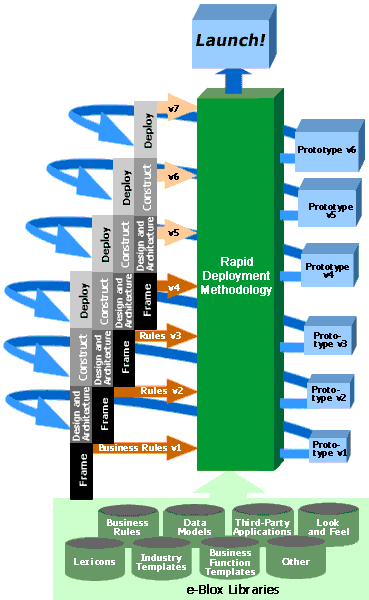 Concept Synthesis is taken straight from the EDA industry,
and is an approach that Euphorion is continually refining
and automating. It is the intelligent interface between
client wants and needs and the technology solution. Euphorion
undertakes early dialogue with clients to understand the
business strategy and uses this insight to develop a first
draft (prototype) solution. We assemble the appropriate
e-Blox, create the interfaces between them, and identify
'holes' where additional components must be added. Euphorion
then refines the first draft prototype with custom components
that are unique to individual client needs (such as graphic
design, business rules and back-end interfaces) and integrates
them into a comprehensive e-solution that is flexible,
scaleable and extensible.
Concept Synthesis is taken straight from the EDA industry,
and is an approach that Euphorion is continually refining
and automating. It is the intelligent interface between
client wants and needs and the technology solution. Euphorion
undertakes early dialogue with clients to understand the
business strategy and uses this insight to develop a first
draft (prototype) solution. We assemble the appropriate
e-Blox, create the interfaces between them, and identify
'holes' where additional components must be added. Euphorion
then refines the first draft prototype with custom components
that are unique to individual client needs (such as graphic
design, business rules and back-end interfaces) and integrates
them into a comprehensive e-solution that is flexible,
scaleable and extensible.
Using this approach, Euphorion can rapidly assemble
prototypes and begin development while the final elements of
strategy are still in development. Because the common elements
of the platform have been integrated and assembled in advance
and have been designed and coded according to industry
standards, the resulting solution is highly flexible. The
entire system is 'change friendly' and can support ongoing
refinement, ensuring rapid time-to-innovation as well as
rapid time-to-market.





